Thoughts
Fragments of thought
Mr. Deer
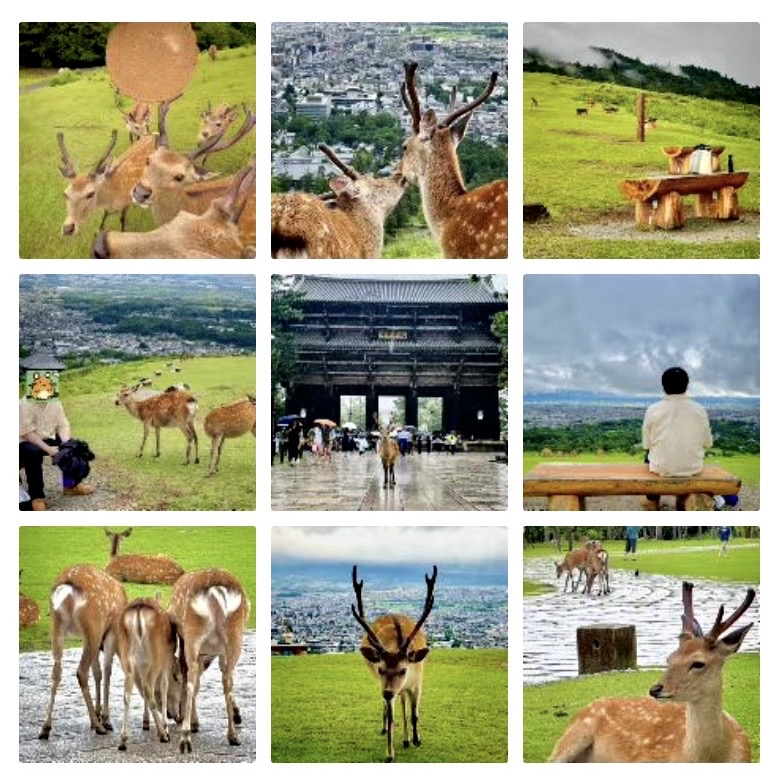
Mr. Deer
"One thousand and seven, one thousand and eight."
Mr. Deer atop the mountain gave a yawn and went on counting the two-legged beasts he'd seen that day. Though he wasn't counting heads, but legs—lifting his head was such a bother.
The newly arrived two-legged beast before him showed no sign of producing a deer cracker.
He chewed on his grass as usual, gazing down at Nara Park at the foot of the mountain. There too was a herd of his own kind, every one of them fat and sleek, sprawled lazily by the roadside—hardly deer-like at all anymore. "Not a shred of ambition," thought Mr. Deer. "If I had endless deer crackers to eat every day, I'd surely have the strength to go see what lies beyond the mountain, instead of just basking in the sun like that pack of fools."
At this thought he yawned again. It had rained a little today, and fewer two-legged beasts had come up the mountain.
Fewer deer crackers too.
"Might as well go down the mountain myself," he said, spitting out the leaf he'd been bitterly chewing. "Grandfather was right—you can't eat pride for a deer cracker." The breeze atop the mountain was pleasant enough, but a pity it still carried that same rank smell of mud when it entered his mouth. Deer-forsaken nuisance. He clicked his tongue. "Ah, forget it. The way down is quite far—can't have my knees worn raw."
Besides, it was still raining today.
"Tomorrow, then. I'll go down tomorrow."
Mr. Deer glanced up at the crow circling overhead, gave a third yawn, and lay down.
The newly arrived two-legged beast before him still showed no sign of producing a deer cracker.
-
Slate Grey
3:24 in the afternoon I hadn't expected this story of the windowsill to have a sequel. The rainy season seems almost over, and moss has sprouted in the crack of the car window—look closely and it's a little troop of furry clusters. Last year's glittering ice crystals have not yet dimmed, and already another year has slipped by. Today, rare for me, I didn'
Slate Grey
3:24 in the afternoon
I hadn't expected this story of the windowsill to have a sequel.
The rainy season seems almost over, and moss has sprouted in the crack of the car window—look closely and it's a little troop of furry clusters.
Last year's glittering ice crystals have not yet dimmed, and already another year has slipped by.
Today, rare for me, I didn't drive out. I walked slowly along the river when a sudden chill caught me off guard; only when I checked my phone did I discover it had already dropped to zero.
Vancouver still hasn't seen snow. We are always hoping for snow, hoping that something wonderful and unforeseen might suddenly fall into our lives, the way a child hopes for candy and gifts to sprout inside a Christmas stocking.
What we hope for does not happen, and what we fear does not happen either—only what has already happened happens. Like the new fragrance I bought smelling so good, like the piano music playing in the tea house sounding so lovely, like the braised pork rice at noon tasting so fine, like the big white dog outside the floor-to-ceiling window running along, tugging a little girl behind it, like some matter I'd agonized over for so long finally being let go.
Perhaps we ought to allow things to happen without needing them to serve either your interests or mine; allow the concrete to triumph over the abstract. A person cannot arrive at understanding except through the concrete experience of living.
Perhaps the world moves as my heart moves. Last year I said the sky was slate grey, I said the shards of ice would keep glittering until the sun rose.
Now the moss before my eyes reflects no light, and so the whole expanse of slate-grey sky has been absorbed into a faint, grassy hue.
That thread of slate grey has crept, just so, along that same line, filling every corner of life, carrying with it a certain dampness, though no droplet can be seen.
Light without glare, still waters running deep.
Like water vanishing into water.
-
Shimmer
3:27 a.m. The snow still hasn't come this year. When I opened the car door there was a distinct resistance, and when I pulled harder it creaked, and a thin crust of ice chips came leaping down in a little procession. Glittering. I let out a long breath, and a streak of white drifted away. So a sigh can be seen, after all. It reminds me of the year befor
Shimmer
3:27 a.m.
The snow still hasn't come this year.
When I opened the car door there was a distinct resistance, and when I pulled harder it creaked, and a thin crust of ice chips came leaping down in a little procession. Glittering.
I let out a long breath, and a streak of white drifted away.
So a sigh can be seen, after all.
It reminds me of the year before last, the first time I watched the snow fall in Vancouver, when the caption I wrote for my friends was "warm the wine, steep the tea, and greet the winter's peace." I don't really know what that line means. I think I'd seen it somewhere once, and it simply surfaced from nowhere just as I was taking those snow photos, and it felt fitting.
Last year there was almost no snow, and this year it seems there won't be much either. In these golden days, time seems to have lost its weight, grown as light as the ice chips on the car door. Time is continuous; the new year, too, will go on as always—the stroke of midnight is no dividing line in a life. And yet there must always be something to look forward to; across the long years, such anticipation settles like sediment in time, and grows only more haunting.
I shut the car door, and I can see that layer of ice once more.
The night air is cold enough to let it go on shimmering along the curve of the car's edge, all the way until the sun comes up.
Like a river. The Milky Way.
And then that line surfaces again, for no reason at all.
"The whole universe will glimmer for you."
-
The Lie of Endless Summer
The endless summer of the millennium came to an end. The autumn wind blew across the gradually withering sea of flowers, carrying away the lie of endless summer, scattering longing and memory. …… The youths of days long past, unseen for so long, gathered once more in that old clubroom. They had all grown up now, and beside them was a group of children as
The Lie of Endless Summer
The endless summer of the millennium came to an end.
The autumn wind blew across the gradually withering sea of flowers, carrying away the lie of endless summer, scattering longing and memory.
……
The youths of days long past, unseen for so long, gathered once more in that old clubroom.
They had all grown up now, and beside them was a group of children as spirited and bright-eyed as they themselves had once been. The middle-aged man at the head of the group spoke slowly, telling the children the story of those years. The children listened with great interest, now and then striking a pose of deep thought, chiming in, vying to answer the little riddles the man posed.
"If it wasn't him who did it, then why did this 'Endless Summer' hydrangea turn up at the scene?"
The boy who was clearly the ringleader of the pack rolled his little eyes round and round.
Suddenly, as if struck by some idea, his eyes lit up.
"It must have been a yōkai who killed him!"
Inside the room, on the small square table, a sugar cube spun and dissolved in a cup of coffee.
The wooden photo frame standing to one side was somewhat old, but had fortunately, it seemed, been carefully polished, and looked very clean. In the photograph, the youths' backs were still full of buoyant joy and hope.
Just as, outside the photograph, the little ones sat gathered round the table.
Outside the room, the wind rose again, ushering in another season of high summer.
The endless sea of blue flowers remained deep and unfathomable, like the tide of the ocean, rising and falling, ebbing and flowing, without end...
-
Autumn When the Bellflowers Fade
This is the final roar of a detective from a bygone era. Surveillance cameras now blanket every street and alley; DNA technology grows more mature by the day. People no longer have need of this once far-famed, gold-medal detective. Perhaps he still wished to shine, but all that remained of his era was the last glow before the sun sank below the horizon. H
Autumn When the Bellflowers Fade
This is the final roar of a detective from a bygone era.
Surveillance cameras now blanket every street and alley; DNA technology grows more mature by the day.
People no longer have need of this once far-famed, gold-medal detective.
Perhaps he still wished to shine, but all that remained of his era was the last glow before the sun sank below the horizon. He was like a candle nearly burned to its end—its flame about to die—clutching the wick tight, straining to burn on a little longer, and then a little longer still. No one paid it any mind. A torch can still pass on people's convictions, can still be a light in the world of the spirit. But he—he had nothing at all. He had been cast aside.
He had tried to struggle on. He chased after it with all his might, unable to let go of the glory that once was his. His moods began to turn extreme; beneath the calm surface of his sea, the waves ran wild.
He was the tip of an iceberg.
But his iceberg had already laid itself bare before everyone's eyes.
His hidden portion lay beneath the surface of the sea. He was an iceberg turned upside down.
The waves kept rolling forward, knocking down both him and the last pride he had left.
The new era had no ship large enough to hold him.
Kawashima Sokiyo drove his white Toyota Corolla up to the cliff's edge.
"Time to log off." He gazed at the distant forest, not knowing to whom he spoke.
He stepped down and out. Just as he had, once, the very first time he walked out of police headquarters.